Co-founder, Cyberatos
The past decade has crystallized the understanding that cyber operations are no longer abstract risks—they produce direct, measurable impacts on physical systems, economic stability, and public safety. Attacks against energy grids, transportation networks, manufacturing facilities, and public utilities have demonstrated that digital intrusions can trigger cascading disruptions, highlighting the critical intersection of cyberspace and the physical world.
By 2025, cyber activity has become a normalized instrument of statecraft. Nation-states increasingly favor persistent, low-intensity campaigns aimed at degrading trust, probing defenses, and exploiting social and political divisions. These campaigns are deliberately ambiguous, leveraging proxies, criminal networks, and ideological actors to obscure attribution and avoid overt escalation. The strategic utility of cyber operations has expanded beyond disruption, encompassing coercion, influence, and leverage across multiple sectors simultaneously.
Critical infrastructure faces dual pressures: strategic targeting by nation-states and opportunistic exploitation by financially motivated actors. Ransomware, data theft, and cryptocurrency-based schemes now serve dual purposes—profit generation and funding of sanctioned regimes or military programs. This convergence eliminates the traditional boundary between criminal activity and state-sponsored operations, creating a permanently contested environment where attacks are continuous, adaptive, and interconnected.
In response, security paradigms have shifted from prevention-focused models toward resilience-oriented strategies. Organizations must assume constant adversarial presence, acknowledge weak deterrence, and recognize that escalation is asymmetric. Operational continuity, redundancy, and rapid recovery define modern security, emphasizing the need for integrated approaches that account for technological interdependence, human and organizational limitations, and the accelerating influence of AI.
The contemporary cyber threat landscape is systemic, persistent, and multifactorial, requiring defensive postures that balance technological innovation, organizational governance, and societal imperatives under conditions of continuous adversarial engagement.
This article progresses from threat evolution and financial impact to critical infrastructure risk, systemic technology fragility, AI amplification, human and organizational limits, and the regulatory response—showing how a decade of structural decisions converges into the 2025 cybersecurity reality.

By 2025, cyber activity has become a normalized instrument of statecraft. Nation-states increasingly favor persistent, low-intensity campaigns aimed at degrading trust, probing defenses, and exploiting social and political divisions. These campaigns are deliberately
ambiguous, leveraging proxies, criminal networks, and ideological actors to obscure attribution and avoid overt escalation. The strategic utility of cyber operations has expanded beyond disruption, encompassing coercion, influence, and leverage across multiple sectors simultaneously.
Critical infrastructure faces dual pressures: strategic targeting by nation-states and opportunistic exploitation by financially motivated actors. Ransomware, data theft, and cryptocurrency-based schemes now serve dual purposes—profit generation and funding of sanctioned regimes or military programs. This convergence eliminates the traditional boundary between criminal activity and state-sponsored operations, creating a permanently contested environment where attacks are continuous, adaptive, and interconnected.
In response, security paradigms have shifted from prevention-focused models toward resilience-oriented strategies. Organizations must assume constant adversarial presence, acknowledge weak deterrence, and recognize that escalation is asymmetric. Operational continuity, redundancy, and rapid recovery define modern security, emphasizing the need for integrated approaches that account for technological interdependence, human and organizational limitations, and the accelerating influence of AI.
The contemporary cyber threat landscape is systemic, persistent, and multifactorial, requiring defensive postures that balance technological innovation, organizational governance, and societal imperatives under conditions of continuous adversarial engagement.
This article progresses from threat evolution and financial impact to critical infrastructure risk, systemic technology fragility, AI amplification, human and organizational limits, and the regulatory response—showing how a decade of structural decisions converges into the 2025 cybersecurity reality.
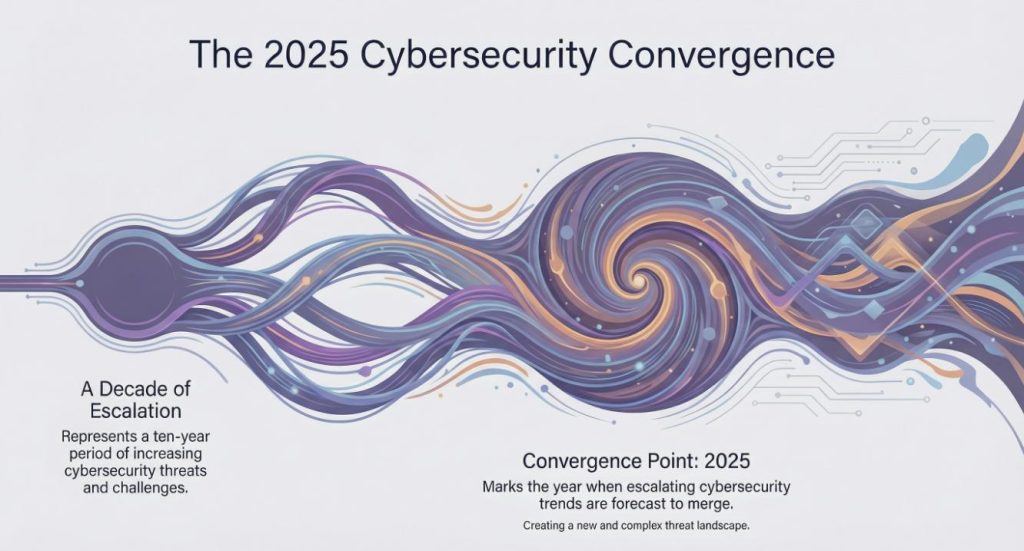
Over the last decade, cyber threats have undergone a structural transformation. Early cybercrime was largely opportunistic: automated scanning, commodity malware, and indiscriminate targeting aimed at volume rather than impact. That phase has largely ended. Modern threat actors operate with intent, patience, and precision, selecting targets based on business criticality, data value, and systemic leverage.
Ransomware exemplifies this evolution. What began as blunt-force encryption has matured into multi-stage extortion campaigns combining credential theft, lateral movement, data exfiltration, and psychological pressure. Encryption is no longer the primary weapon; it is a negotiating tool. Attackers now prioritize theft of sensitive, regulated, or operationally essential data, enabling extortion even when backups exist and recovery is technically possible.
Attack preparation has become more deliberate. Initial access increasingly occurs weeks or months before impact through phishing, infostealers, and abuse of exposed cloud identities. Stolen credentials are validated, sold, and reused across campaigns, allowing attackers to blend into legitimate activity. By the time an incident is detected, adversaries often already understand internal processes, dependencies, and failure points better than defenders.
Targeting has also shifted up the value chain. Critical infrastructure, healthcare, education, manufacturing, and technology supply chains are favored not because of weak security alone, but because of low tolerance for disruption and high downstream impact. Single intrusions now cascade across suppliers, partners, and customers, multiplying leverage and damage without additional attacker effort.
Scale and sophistication now coexist. While individual attacks are more precise, overall attack volume continues to rise through automation and AI-assisted tooling. Threat actors combine mass reconnaissance with tailored execution, overwhelming organizations that rely on perimeter defenses, static controls, or delayed detection.
The defining characteristic of this phase is asymmetry. Attackers choose timing, terrain, and technique. Defenders inherit complexity, legacy systems, and business constraints. This imbalance—rather than technical weakness alone—explains why precision attacks succeed at scale.By 2025, cyber activity has become a normalized instrument of statecraft. Nation-states increasingly favor persistent, low-intensity campaigns aimed at degrading trust, probing defenses, and exploiting social and political divisions. These campaigns are deliberately
ambiguous, leveraging proxies, criminal networks, and ideological actors to obscure attribution and avoid overt escalation. The strategic utility of cyber operations has expanded beyond disruption, encompassing coercion, influence, and leverage across multiple sectors simultaneously.
Critical infrastructure faces dual pressures: strategic targeting by nation-states and opportunistic exploitation by financially motivated actors. Ransomware, data theft, and cryptocurrency-based schemes now serve dual purposes—profit generation and funding of sanctioned regimes or military programs. This convergence eliminates the traditional boundary between criminal activity and state-sponsored operations, creating a permanently contested environment where attacks are continuous, adaptive, and interconnected.
In response, security paradigms have shifted from prevention-focused models toward resilience-oriented strategies. Organizations must assume constant adversarial presence, acknowledge weak deterrence, and recognize that escalation is asymmetric. Operational continuity, redundancy, and rapid recovery define modern security, emphasizing the need for integrated approaches that account for technological interdependence, human and organizational limitations, and the accelerating influence of AI.
The contemporary cyber threat landscape is systemic, persistent, and multifactorial, requiring defensive postures that balance technological innovation, organizational governance, and societal imperatives under conditions of continuous adversarial engagement.
Over the last decade, cyber threats have undergone a structural transformation. Early cybercrime was largely opportunistic: automated scanning, commodity malware, and indiscriminate targeting aimed at volume rather than impact. That phase has largely ended. Modern threat actors operate with intent, patience, and precision, selecting targets based on business criticality, data value, and systemic leverage.
Ransomware exemplifies this evolution. What began as blunt-force encryption has matured into multi-stage extortion campaigns combining credential theft, lateral movement, data exfiltration, and psychological pressure. Encryption is no longer the primary weapon; it is a negotiating tool. Attackers now prioritize theft of sensitive, regulated, or operationally essential data, enabling extortion even when backups exist and recovery is technically possible.
Attack preparation has become more deliberate. Initial access increasingly occurs weeks or months before impact through phishing, infostealers, and abuse of exposed cloud identities. Stolen credentials are validated, sold, and reused across campaigns, allowing attackers to blend into legitimate activity. By the time an incident is detected, adversaries often already understand internal processes, dependencies, and failure points better than defenders.
Targeting has also shifted up the value chain. Critical infrastructure, healthcare, education, manufacturing, and supply chains are favored not because of weak security alone, but because of low tolerance for disruption and high downstream impact. Single intrusions now cascade across suppliers, partners, and customers, multiplying leverage and damage without additional attacker effort.
Scale and sophistication now coexist. While individual attacks are more precise, overall attack volume continues to rise through automation and AI-assisted tooling. Threat actors combine mass reconnaissance with tailored execution, overwhelming organizations that rely on perimeter defenses, static controls, or delayed detection.
The defining characteristic of this phase is asymmetry. Attackers choose timing, terrain, and technique. Defenders inherit complexity, legacy systems, and business constraints. This imbalance—rather than technical weakness alone—explains why precision attacks succeed at scale.
By 2025, cyber activity has become a normalized instrument of statecraft. Nation-states increasingly favor persistent, low-intensity campaigns aimed at degrading trust, probing defenses, and exploiting social and political divisions. These campaigns are deliberately ambiguous, leveraging proxies, criminal networks, and ideological actors to obscure attribution and avoid overt escalation. The strategic utility of cyber operations has expanded beyond disruption, encompassing coercion, influence, and leverage across multiple sectors simultaneously.
Critical infrastructure faces dual pressures: strategic targeting by nation-states and opportunistic exploitation by financially motivated actors. Ransomware, data theft, and cryptocurrency-based schemes now serve dual purposes—profit generation and funding of sanctioned regimes or military programs. This convergence eliminates the traditional boundary between criminal activity and state-sponsored operations, creating a permanently contested environment where attacks are continuous, adaptive, and interconnected.
In response, security paradigms have shifted from prevention-focused models toward resilience-oriented strategies. Organizations must assume constant adversarial presence, acknowledge weak deterrence, and recognize that escalation is asymmetric. Operational continuity, redundancy, and rapid recovery define modern security, emphasizing the need for integrated approaches that account for technological interdependence, human and organizational limitations, and the accelerating influence of AI.
The contemporary cyber threat landscape is systemic, persistent, and multifactorial, requiring defensive postures that balance technological innovation, organizational governance, and societal imperatives under conditions of continuous adversarial engagement.
This article progresses from threat evolution and financial impact to critical infrastructure risk, systemic technology fragility, AI amplification, human and organizational limits, and the regulatory response—showing how a decade of structural decisions converges into the 2025 cybersecurity reality.

Cybercrime has transitioned from an operational risk into a sustained economic drain with macroeconomic consequences. Annual global losses now reach into the trillions, driven not only by ransom payments and breach remediation, but by prolonged downtime, regulatory penalties, litigation, lost productivity, and erosion of customer and investor confidence.
Average breach costs continue to rise across all regions, with large enterprises and critical service providers routinely facing multi-million-dollar incidents. In many cases, indirect costs outweigh direct response expenses. Business interruption, delayed production, supply chain disruption, and long-term reputational damage persist well beyond technical recovery.
The concentration of digital infrastructure amplifies financial impact. A single incident affecting a dominant platform, cloud provider, or software vendor can impose losses across thousands of organizations simultaneously. These cascading effects increasingly spill into national economies, affecting employment, public services, and market stability.
As cyber incidents scale economically, they reshape risk models. Cybersecurity is no longer insurable in the traditional sense for many organizations; premiums rise sharply, coverage narrows, and exclusions expand. The financial reality of modern cyber risk is not episodic loss, but chronic economic pressure.
Ransomware exemplifies this evolution. What began as blunt-force encryption has matured into multi-stage extortion campaigns combining credential theft, lateral movement, data exfiltration, and psychological pressure. Encryption is no longer the primary weapon; it is a negotiating tool.
Attack preparation has become more deliberate. Initial access increasingly occurs weeks or months before impact, allowing adversaries to study internal processes, dependencies, and failure points before detection.
Targeting has shifted up the value chain. Critical infrastructure, healthcare, education, manufacturing, and technology supply chains are favored due to low tolerance for disruption and high downstream impact, enabling single intrusions to cascade across entire ecosystems.
Scale and sophistication now coexist. Automation and AI-assisted tooling increase overall attack volume while enabling precision execution, overwhelming organizations reliant on static defenses or delayed detection.
The defining characteristic of this phase is asymmetry. Attackers choose timing, terrain, and technique; defenders inherit complexity, legacy systems, and business constraints. This imbalance—not technical weakness alone—explains why precision attacks succeed at scale.
By 2025, cyber activity has become a normalized instrument of statecraft, expanding beyond disruption into coercion, influence, and cross-sector leverage.
The past decade removed any remaining ambiguity about the real-world consequences of cyber operations. Attacks against energy grids, fuel distribution, manufacturing, transportation, and public utilities have demonstrated that digital incidents can trigger physical disruption, economic shock, and public safety risks.
By 2025, cyber activity has become a normalized instrument of state power. Rather than singular, catastrophic strikes, nation-states favor persistent pressure campaigns designed to degrade trust, probe defenses, and exploit political and social fractures. Attribution is deliberately blurred through proxy groups, criminal partnerships, and ideological hacktivist fronts, allowing states to apply pressure while avoiding direct escalation.
Critical infrastructure operators face a dual threat. They are targeted both for strategic signaling and for leverage, as disruption carries immediate societal consequences. Water systems, power grids, healthcare networks, and transportation systems increasingly experience intrusion attempts intended to test response thresholds rather than cause immediate destruction.
Financially motivated cybercrime and geopolitical objectives are now intertwined. Ransomware, data theft, and cryptocurrency exploitation are used not only for profit but to fund sanctioned regimes and sustain military programs. This convergence collapses the traditional distinction between criminal activity and state-sponsored operations.
The result is a permanently contested digital environment. Infrastructure must now be defended under the assumption of continuous adversarial presence, where deterrence is weak, escalation is asymmetric, and resilience—not prevention alone—defines security.
Average breach costs continue to rise across all regions, with large enterprises and critical service providers routinely facing multi-million-dollar incidents. In many cases, indirect costs outweigh direct response expenses. Business interruption, delayed production, supply chain disruption, and long-term reputational damage persist well beyond technical recovery.
The concentration of digital infrastructure amplifies financial impact. A single incident affecting a dominant platform, cloud provider, or software vendor can simultaneously impose losses across thousands of organizations. These cascading effects increasingly spill into national economies, affecting employment, public services, and market stability.
As cyber incidents scale economically, they reshape risk models. Cybersecurity is no longer insurable in the traditional sense for many organizations, premiums rise sharply, coverage narrows, and exclusions expand. The financial reality of modern cyber risk is not episodic loss, but chronic economic pressure.
Attack preparation has become more deliberate. Initial access increasingly occurs weeks or months before impact, enabling adversaries to understand internal processes, dependencies, and failure points before detection.
This article progresses from threat evolution and financial impact to infrastructure risk, systemic fragility, AI amplification, organizational limits, and regulatory response—showing how a decade of structural decisions converges into the 2025 reality.
Modern critical infrastructure is deeply intertwined with digital systems, creating unprecedented efficiency while amplifying vulnerability. Industrial control systems, networked sensors, automated logistics, and cloud-dependent operations form tightly coupled architectures where a single compromise can cascade across multiple sectors. This interdependence extends beyond physical assets, linking supply chains, financial systems, and communication networks in ways that allow localized disruption to ripple globally.
Structural fragility is compounded by legacy systems lacking modern security controls, alongside increasingly complex technology stacks that are difficult to fully monitor or patch. Dependence on third-party vendors, cloud providers, and open-source components introduces additional attack surfaces exploitable through indirect compromise. The result is an ecosystem where connectivity increases operational risk, making resilience a fundamental requirement rather than an optional objective.
Defense strategies must account for these interdependencies, emphasizing segmentation, redundancy, and continuous monitoring. Failure to recognize the fragility of highly digitized networks risks cascading failures, systemic outages, and amplified societal consequences from even limited cyber incidents.
By 2025, cyber activity has become a normalized instrument of state power, characterized by persistent pressure rather than singular catastrophic attacks. Critical infrastructure operators now face continuous adversarial presence, where deterrence is weak, escalation is asymmetric, and resilience—not prevention alone—defines security.
This article connects infrastructure fragility, economic impact, threat evolution, AI amplification, and governance limits—showing how structural dependencies converge into the 2025 cybersecurity reality.

Artificial intelligence has transformed both offensive and defensive cyber operations into scalable, persistent, and highly adaptive endeavors. On the offensive side, AI enables automated reconnaissance, vulnerability discovery, and exploitation at speeds and volumes far beyond human capability. Machine learning models can sift through vast data sources to identify weak points, predict defensive behavior, and optimize attack vectors. Generative AI further enables highly convincing social engineering, phishing, and adaptive malware.
Defensively, AI provides enhanced situational awareness, anomaly detection, and rapid response automation. Systems can learn normal operational patterns to flag subtle deviations and deploy countermeasures in real time. However, the same tools that amplify defense also magnify risk, as attackers leverage AI to bypass safeguards, evade detection, and coordinate continuous multi-vector campaigns.
The net effect is force multiplication across the cyber domain. AI lowers the threshold for conducting complex operations, compresses decision timelines, and scales impact. This creates a fundamentally asymmetric environment, where small AI-enabled actors can achieve effects once reserved for large, well-resourced teams.
In infrastructure contexts, AI’s role is particularly acute. Systems that depend on AI for efficiency or predictive maintenance can themselves become attack vectors if models or data streams are manipulated. Consequently, AI does not merely augment cyber capabilities—it reshapes the operational calculus, making resilience and adversarial robustness central to both strategy and daily operations.
Even as technology evolves, human and organizational factors remain critical limits on cybersecurity effectiveness. Skilled personnel are scarce, and the pace of innovation in attack techniques outstrips the ability of many teams to recruit, train, and retain talent. High turnover, burnout, and uneven expertise create gaps in detection, response, and threat anticipation, leaving infrastructure vulnerable despite advanced tools.
Organizational structures often amplify these vulnerabilities. Siloed departments and fragmented decision-making slow response and obscure accountability during crises. Risk perception is uneven: executives may prioritize continuity or cost efficiency, while technical teams lack authority or resources. Policies and compliance frameworks frequently lag behind emerging threats, leaving defenders reactive rather than proactive.
Cognitive biases compound risk. Persistent, low-intensity campaigns are underestimated, perimeter defenses are overtrusted, and subtle manipulation of data and processes goes unnoticed. Social engineering exploits these behaviors, bridging technical weaknesses and real-world impact.
Mitigating these constraints requires integrating culture, governance, and continuous training into the cybersecurity posture. Resilience depends not only on technology, but on aligning incentives, authority, and situational awareness across the organization.
Defensively, AI enhances situational awareness, anomaly detection, and rapid response automation, but the same tools also magnify risk by enabling attackers to bypass safeguards and coordinate continuous multi-vector campaigns.
The net effect is force multiplication and asymmetry. AI compresses decision timelines and scales impact, allowing small actors to achieve outsized effects, while defenders must innovate continuously to keep pace.
In infrastructure environments, AI reshapes the operational calculus, making resilience and adversarial robustness central to both strategy and daily operations.
The regulatory landscape governing critical infrastructure has struggled to keep pace with modern cyber threats. Prescriptive compliance frameworks, built around checklists and historical risk patterns, fail to capture the continuous, adaptive, and asymmetric nature of contemporary operations. While regulation establishes baselines, it cannot substitute for operational agility and resilience under persistent adversarial pressure.
Resilience has become the defining metric of security. Organizations can no longer rely solely on prevention; systems must absorb, contain, and recover from breaches without catastrophic disruption. This requires a shift from reactive patching to proactive strategies, including redundancy, robust incident response, supply chain diversification, and continuous stress testing under realistic threat conditions. Recovery timelines, interdependencies, and cascading effects must be understood to ensure societal functions remain intact during sustained attacks.
Reality imposes further constraints. Even well-resourced entities face limited visibility into complex networks, unknown legacy vulnerabilities, and deep third-party dependencies. Geopolitical dynamics, financial pressures, and competing priorities frequently undermine ideal controls. Regulation alone is insufficient without integration into a broader technical, organizational, and societal strategy.
The intersection of regulation, resilience, and reality underscores a fundamental truth: cybersecurity is not a static compliance problem. It is a dynamic risk management challenge requiring continuous adaptation, investment, and strategic foresight. Organizations must plan for sustained adversarial engagement, accepting that failure cannot be eliminated—only managed and mitigated in real time.
The evolution of cyber operations over the past decade reveals a landscape defined by persistent, multifaceted, and interdependent threats. Nation-states leverage digital capabilities not for singular, dramatic strikes but for continuous pressure campaigns that exploit political, social, and technological vulnerabilities. Financially motivated actors intersect with geopolitical objectives, collapsing traditional distinctions between crime and state-sponsored activity. Critical infrastructure becomes a vector for strategic influence rather than a target of opportunity.
Technology dependence amplifies structural fragility. Highly digitized systems, tightly coupled supply chains, and legacy infrastructure create cascading vulnerabilities, where a single compromise can trigger widespread operational and societal consequences. Artificial intelligence acts as a force multiplier, increasing both offensive reach and defensive capacity while magnifying asymmetry.
Human and organizational factors remain a persistent constraint. Talent shortages, structural inefficiencies, cognitive biases, and misaligned incentives limit the effectiveness of advanced technical solutions. Governance, culture, and decision-making determine whether investments translate into resilience.
Regulation and compliance provide a foundation, but they cannot replace adaptive response in a permanently contested environment. Resilience—not prevention alone—defines security, built through redundancy, segmentation, monitoring, and rehearsed response under the assumption of inevitable intrusion.
In sum, the contemporary cyber landscape demands a holistic, anticipatory posture. Success is measured not by the absence of incidents, but by the capacity to detect, absorb, and recover while maintaining societal function and operational integrity.